
Expedia API Alternative: Compare Without the Partner Gate
Expedia does not provide a public API.
The Expedia API most people search for is Expedia Rapid — a partner-only lodging, cars, flights, and activities stack. You do not get a key by opening the docs. You apply. A business development manager reviews your case. Then your key is in restricted development mode until after a site review. Then production.
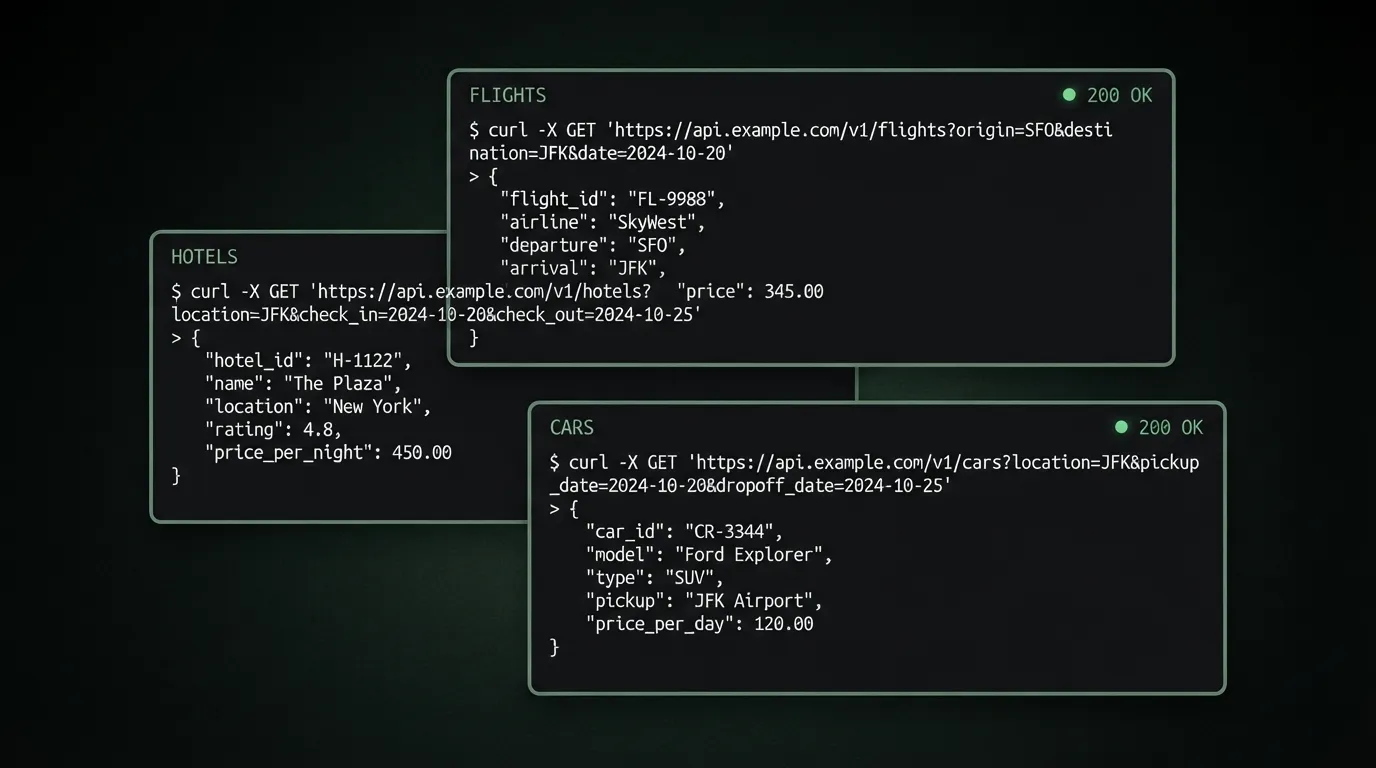
This is not a recent change. Rapid has always been a B2B partner product, not a public developer tool. If you found a tutorial showing curl examples against Expedia endpoints, those responses came from an approved partner account — not a free public sandbox.
This page draws that line: what Rapid actually is, what it covers, and what to use when you need search-and-compare without the full partner gate.
Ktemia’s own contracts stay on their own posts: flight search API, car rental API, and hotel search AI. Routes are not live yet. No invented Expedia prices here.
Key Takeaways
- Expedia does not provide a public API. Rapid is partner-only — application, site review, and a business development manager before production.
- Rapid V3 covers lodging, cars, flights, and activities. It is a shop-to-book path, not a comparison-only product.
- The Expedia Developer Portal launched Typeahead in September 2025 and Merchandising in August 2025 — both V3 only, both require separate account manager approval.
- Ktemia: one POST per vertical, search only, 50 free requests a month. No partner application, no site review.
Does Expedia have a public API?
No. This is the sentence most tutorials skip.
Expedia Group’s Rapid API landing page says it plainly: “All applications will be reviewed case by case.” There is no “sign up and get a key” flow. There is no free public sandbox. There is no open developer portal where you register with an email address and start making calls.
Compare this to how most developers expect APIs to work: open the docs, register, get a test key, make a call. Rapid works the opposite way. You apply as a business. Expedia reviews whether you are a viable distribution partner. If approved, you get a test key in restricted mode. Then you build, meet launch requirements, request a site review, and only then does a business development manager enable your production key on api.ean.com.
That process exists because Rapid is a B2B distribution contract, not a developer utility. You are not querying a search index. You are becoming an Expedia distribution partner — with the compliance, branding, and display requirements that come with it.
This distinction matters for how you plan. If your sprint starts with “add Expedia API,” the first task is not writing a fetch call. It is a business development conversation. Teams that discover this on week three have already built the integration shape against the wrong assumption.
What is Expedia Rapid API?
Expedia Group’s Rapid API landing page (retrieved 25 September 2026) describes Rapid as a fast, light API with a modular structure that lets you customize a lodging path from shopping, to booking, to payment. All applications are reviewed case by case.
Their developer hub getting started (retrieved 25 September 2026) is explicit: to integrate with Rapid API, you need to be an Expedia partner. You apply. You get an API key from the Portal. That key is in restricted development mode until a site review. Your business development manager enables the production key when the review passes. Endpoints switch from test.ean.com to api.ean.com.
That flow is not a public sandbox. It is a B2B distribution agreement with a compliance gate.
Partner application reviewed case by case. No instant key.
Test key on test.ean.com. Restricted mode. Site review required.
Business development manager enables production on api.ean.com.
The SERP for expedia api is full of tutorials showing JSON responses. None of them explain that those responses came from an approved partner account. Copying the shape of Rapid endpoints onto a self-built stack is not an Expedia API integration. It is a prototype with invented data.
What does Expedia Rapid API actually cover?
The Expedia Developer Hub (retrieved 25 September 2026) lists four main lines of business under Rapid: Lodging, Cars, Flights, and Activities.
Lodging is the primary and most mature path. It covers shopping, booking, payment, content, and post-booking management. The lodging path is what most partners use. It includes a search-to-book flow — shop with dates and occupancy, price check, book with guest and payment.
Cars follows a similar path. GET /cars/availability searches; GET /cars/{car_rental_id}/details shows the breakdown; POST /itineraries/car completes the booking. Expedia claims 47,000 vendors across more than 190 countries on this route.
Flights adds shop, details, payment token, and create booking endpoints. Same partner gate. Same site review.
Activities is more recent. The 2025 highlights post from the Expedia Group B2B team mentions an acquisition of Tiqets (an experiences platform) as part of broadening Rapid’s activities inventory.
All four require the same thing: an approved Expedia partner agreement before any of it is live.
What changed in Rapid API recently?
The Rapid changelog shows active development in V3:
- May 2026: Merchandising Shop Link added — allows partners to proceed to a property page with selected promotion information from the Merchandising response.
- January 2026: Credit Card Recapture added — a new Book feature on V3.
- December 2025: Sanction Screening (Book, V3) and Holdable Rates (Shop, V3).
- September 2025: Typeahead API launched — autocomplete for lodging search by geographic region. Requires your account manager to add it; not available by default even for existing partners.
- August 2025: Merchandising and Marketing Fee Details — promotional campaigns and email/banner content via API.
V2.3 and V2.4 have been deprecated. Versioning policy: deprecated versions stay available for one year before retirement. Breaking changes only ship in new versions. If you are on an older version, check the changelog before assuming your integration still works.
The Typeahead API point is easy to miss. Even if you are an approved Rapid V3 partner, Typeahead is not on by default. You need your account manager to amend your agreement. This is a pattern across Rapid: each feature addition can require a separate access request, not just a code change. “I have a Rapid key” is not the same as “I have access to every endpoint in the docs.”
How is Expedia Rapid different from Booking.com Demand API?
Both are partner-gated shop-to-book stacks. The differences are inventory ownership and geographic coverage.
| Expedia Rapid | Booking.com Demand API | |
|---|---|---|
| Gate | Partner application, site review | Affiliate partner approval |
| Primary strength | Lodging, global inventory | Accommodations, European depth |
| Cars | Yes, 47,000 vendors claimed | Yes, Beta booking in v3.2 |
| Flights | Yes, shop-to-book | Not in lodging Demand API |
| Booking in API | Yes | Stable redirect; in-app booking in Beta |
| Key type | API key + shared secret, SHA-512 auth | Bearer token + affiliate ID |
Car rental API has the full Booking.com Demand API car flow. For hotels, the Booking.com API post draws the search-vs-book line on that stack. Neither is Ktemia. Neither is a public search-only endpoint.
What if you only need search-and-compare?
Rapid is a booking API. The shop step exists so partners can offer and then complete the reservation. If you never plan to take payment, you are onboarding the full booking stack for the comparison step. That is a partner agreement, a site review, a compliance audit, and a business development manager relationship — for a JSON list of hotel prices.
If the job is compare without the checkout, there is a different category of product. Skyscanner Live Prices is search-only, partner-reviewed. Ktemia is search-only, no partner agreement.
Ktemia’s contract for the same three verticals:
# Flights
requests.post("https://api.ktemia.com/v1/flights", json={
    "origin": "LIS", "destination": "LHR", "depart": "2026-10-12"
})

# Hotels
requests.post("https://api.ktemia.com/v1/hotels", json={
    "city": "London", "checkin": "2026-10-12", "checkout": "2026-10-19"
})

# Cars
requests.post("https://api.ktemia.com/v1/cars", json={
    "pickup": "LHR", "pickup_date": "2026-10-12T10:00:00",
    "dropoff_date": "2026-10-19T10:00:00", "driver_age": 30
})
Required fields, or the API rejects and names what is missing. The copilot asks instead of guessing. No partner application. No site review. Free is free: 50 API requests a month, full dashboard access.
These routes are not live yet. A successful search will still not be a ticket, confirmation, or voucher. The job is comparison — same boundary as Expedia’s shop step, without the booking path attached.
What must you not guess?
On Expedia Rapid Lodging: the destination region or property ID, check-in and checkout dates, number of adults. On the cars endpoint: pickup location, dates, driver age. On flights: origin, destination, departure date.
On Ktemia, the same discipline: if a required field is missing, the call must fail and name it. The copilot asks. It must not invent London because the user said “next week in the UK.” On Free, you get 50 API requests a month across every route. A wrong city on flights draws down the same pool the hotels search would have used — a wasted call either way.
Never put an Expedia API key, a Booking.com partner secret, or a Ktemia dashboard key into frontend JavaScript. Expedia’s own authentication docs require HTTPS-only with an SHA-512 signature. The key is visible in your Portal. It is not for the browser.
Search without the booking gate.
Expedia Rapid is a serious partner product. It covers lodging, cars, flights, and activities end-to-end. The gate exists because you are handling reservations on behalf of travellers. If that is your product, apply.
If the job is compare — show your users fares and rates they can rank, without your platform creating an order — the booking stack is the wrong entry point.
Ktemia is that search row. Flights, hotels, cars, and real estate in one platform. One POST each. Ask when a field is missing. Routes not live. When they are, this page gets a dated response, not invented Expedia inventory.
Start from product and pricing caps. Docs has the contract when the routes exist. The wider set of alternatives, ranked by whether you can get a key at all, is in best travel API.
Sources
- Expedia Group, Get Started with Rapid API (retrieved 2026-09-25)
- Expedia Group Developer Hub, Get started with Rapid API (retrieved 2026-09-25)
- Expedia Group Developer Hub, Rapid API overview (retrieved 2026-09-25)
- Expedia Group Developer Hub, Rapid API changelog (retrieved 2026-09-25)
- Expedia Group Developer Hub, Rapid Car API (retrieved 2026-09-25)
- Expedia Group Developer Hub, Lodging API versioning schedule (retrieved 2026-09-25)
- Expedia Group Blog, Building the Next Generation of B2B Travel Technology: 2025 Highlights (retrieved 2026-09-25)
- Ktemia, Car Rental API: Compare Vehicles and Prices (retrieved 2026-09-25)
- Ktemia, Pricing (retrieved 2026-09-25)
- Ktemia, Terms of Service (retrieved 2026-09-25)
FAQ
Is the Expedia API public?
No. Expedia does not offer a public API. Rapid requires a partner application reviewed case by case, an API key from the Portal, and a business development manager to enable your key for production. There is no public sandbox you can query today.
What does Expedia Rapid API cover?
Rapid covers lodging, cars, flights, and activities. The main path is search-to-book for hotels. Cars and flights follow a similar shop-then-book flow. All require partner approval and a site review before production access.
What is an Expedia API alternative for search-and-compare?
Ktemia's POST /v1/flights, /v1/hotels, and /v1/cars return comparable offers for the same verticals. Free is free — 50 API requests a month, no partner application, no site review. Routes are not live yet.
Does the Expedia API book hotels and flights?
Yes, with partner approval. Rapid is a shop-to-book path. Shop returns offers. Book creates an order and takes payment. If you only need comparison, you are integrating the full booking stack for the search step.
What if I only want to compare prices, not book?
Rapid is designed as a booking API. Search is the shop step on a booking path, not a standalone comparison product. Ktemia is search-and-compare only. The contract does not issue a ticket, confirmation, or voucher.